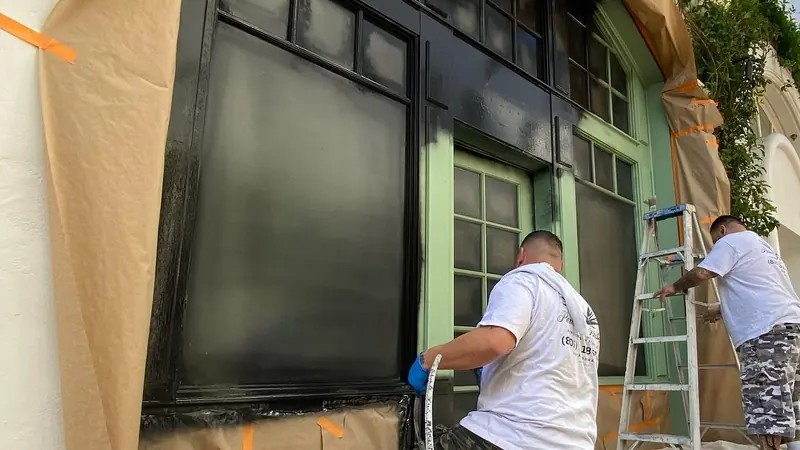
Dry rot repair before painting in Simi Valley is the step that decides whether an exterior paint job lasts or starts peeling at the same soft corners. Paint cannot bond to wood that is soft, swollen or crumbling, and painting over rot only hides it until the next wet winter.
We do this work only as part of an exterior painting project. Think of it as surface prep for wood: we fix fascia, trim and siding so new paint has something sound to hold onto. If you need carpentry without painting, a finish carpenter is the better call.
Repairs and paint are priced together in one itemized estimate, so you can see exactly which boards are being fixed and how. It is all part of our exterior house painting process.
Exterior Wood We Repair Before Painting
We probe and repair the exterior wood that paint depends on, then prime and paint it in the same project.
Fascia, Barge and Rake Boards
Fascia rots first at corners and behind gutters, where water sits against the back of the board. Barge and rake boards along the sloped roof edges catch wind-driven rain on their exposed ends. We cut back to dry wood, splice in or replace the section with stock matched to the profile, and prime the bare wood, cut ends included.
Rafter Tails and Exposed Eaves
Exposed rafter tails reach past the roof edge with their end grain facing the weather, so they soak up rain and sprinkler water. Small areas of rot near the tip are often a good fit for epoxy, shaped to match the neighboring tails before primer. If the rot runs back toward the wall line, where the tail becomes part of the roof framing, we stop and show you before going further.
Window Trim and Sills
Water collects at the bottom corners of window trim and on flat sills, then soaks into the end grain wherever a miter joint has opened. Shaped or older trim profiles can often be saved with epoxy filler carved to match, which keeps the original look around the window. Joints are recaulked after priming so the next rain runs off instead of in.
Door Frames, Casings and Garage Jambs
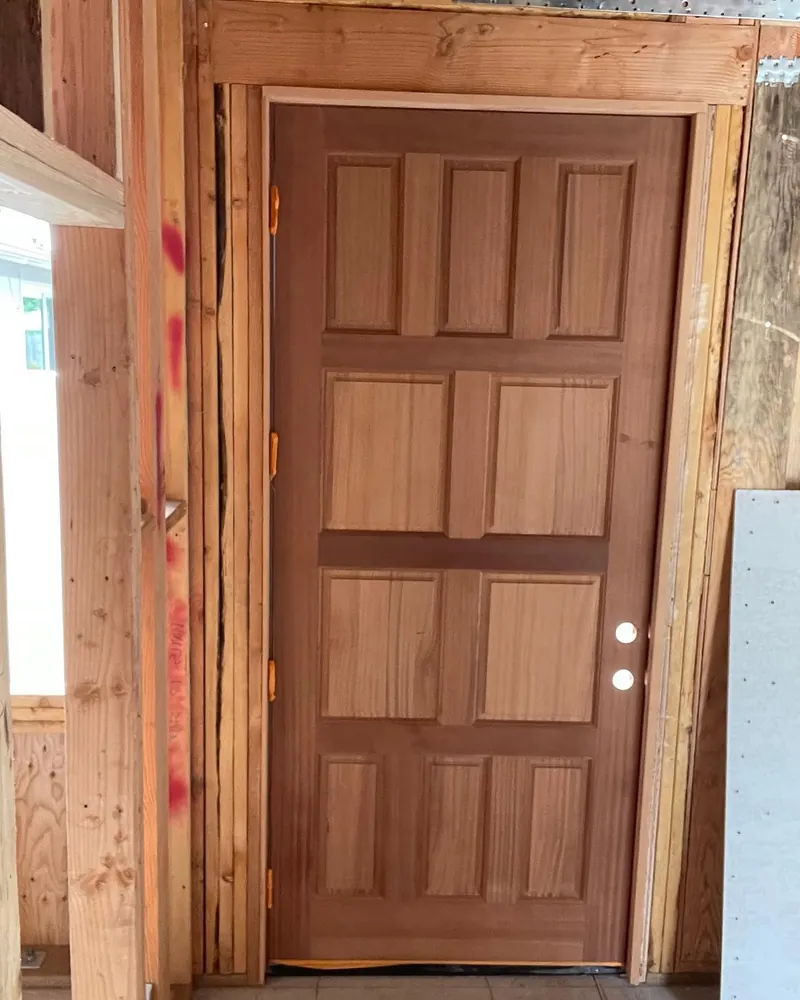
Door frames usually rot in the bottom few inches, where rain and sprinkler spray collect at the threshold. Garage door jambs take splash-back from the driveway and nearby sprinklers. We cut out the soft section, fit a new piece or rebuild it with epoxy, and seal the joint where wood meets concrete so water stops wicking up.
Wood siding and trim boards, including trim set into stucco walls, get the same probe-and-repair treatment. Load-bearing framing, posts and beams are outside our scope. If rot reaches structure, we stop and tell you before we paint.
Warning Signs of Rotted Trim and Fascia
- Paint peeling or blistering on one board while the rest of the house looks fine.
- Wood that gives under a screwdriver instead of resisting it.
- Dark stains, swelling or splitting at board ends and joints.
- Wood broken into small cube-shaped cracks.
- Open miter joints at window and door corners.
- Gutters that overflow or drip behind the fascia.
Piles of tiny six-sided pellets point to drywood termites instead, a job for a licensed pest control company.
How We Repair Rotted Wood and Paint Over It
- Probe every board. We check fascia, trim, sills and siding with a probe, not just by eye.
- Find the water. A sprinkler head, clogged gutter or failed caulk is usually behind the rot. We show you the source, because a repair without a fix for the water is temporary.
- Write it up. Each spot is listed in the estimate as an epoxy repair or a replacement.
- Cut out the rot back to solid, dry wood.
- Repair or replace. Small areas get epoxy consolidant and filler shaped to match; larger damage gets new wood cut to the same profile.
- Prime all bare wood, including cut ends.
- Caulk and paint. Joints are sealed, then the house is painted with premium exterior acrylic.
- Walk through. You review repairs and paint with us before final payment.
Epoxy Fill or New Wood: Repair Methods Compared
| Method | Best for | How it works | Trade-offs |
|---|---|---|---|
| Epoxy consolidant and filler | Small, local rot in sills, corners and shaped trim | Rot is dug out, remaining fibers are hardened with liquid epoxy, then the void is filled and shaped | Keeps original trim; not suited to rot along a whole board |
| Partial replacement | Rot at one end of a long fascia or trim board | The damaged section is cut out and a new piece is spliced in | Less material; needs a carefully made joint |
| Full board replacement | Rot through the board or in several spots | The board is replaced with new, primed wood matched to the profile | Most durable for widespread rot; more labor and material |
What Changes the Cost of Dry Rot Repair
Dry rot repair before painting in Simi Valley is priced spot by spot. What moves the number:
- How far the rot goes. Surface rot is quick to fix; rot running inside a board means replacement.
- Height and access. Second-story fascia takes more ladder work than a front door frame.
- Profile matching. Older or decorative trim takes more work to match.
- Number of locations. Ten small epoxy repairs can take longer than one board replacement.
- Hidden damage. If we find more rot once a board is off, we stop, show you, and price it in writing before continuing.
Dry Rot Repair Before Painting in Simi Valley: Sun, Sprinklers and Salt Air
Rot here rarely starts with rain alone. In Simi Valley, Moorpark and Thousand Oaks, strong summer sun cracks the paint film on south- and west-facing fascia, and daily sprinkler overspray soaks the trim and garage jambs nearest the lawn. Water gets in through those cracks and dries out slowly behind the paint.
Closer to the coast in Ventura, Oxnard and Port Hueneme, marine moisture keeps wood damp longer. UC pest researchers also describe drywood termites as common along California's Pacific coastal region, so we watch for pellets while we probe. That mix is why dry rot repair before painting in Simi Valley looks different from one house to the next.