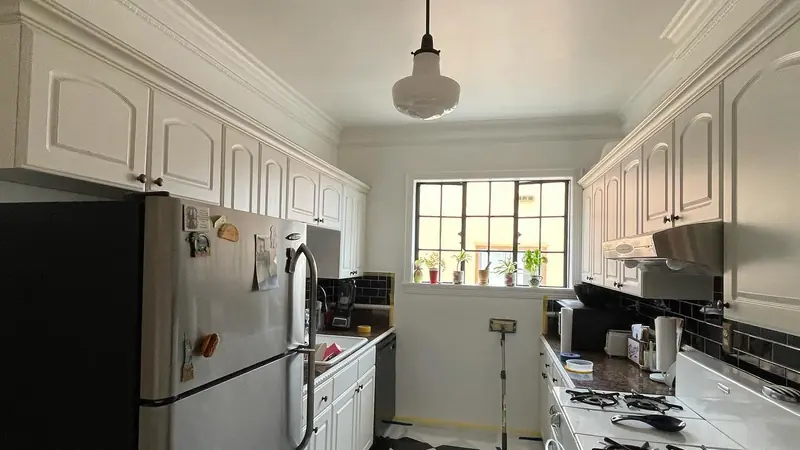
Drywall repair before painting in Simi Valley is something we do inside a painting project, never as a stand-alone handyman call. When we paint a room, we fix what fresh paint would otherwise put on display: doorknob holes, nail pops, hairline cracks over doors, old anchor holes and the dents every hallway collects.
So if you only need a hole patched, we are not the right call. If you are repainting a room or the whole house, the repairs go into the same written, itemized estimate, handled by the same crew on the same schedule as the paint.
New paint is honest about the surface under it. A patch that sits high, a caulked crack or an unprimed repair shows the moment light hits the wall from the side, which is why repairs are the first stage of our interior painting process.
What Our Pre-Paint Drywall Repair Covers
Every repair below is done as the first stage of painting the room, and each one is listed on your estimate.
Doorknob Holes, Anchor Holes and Dings
Small holes from hooks, anchors and furniture are filled and sanded flat. Doorknob and impact holes are cut square, backed, patched with new drywall and taped, so the repair is as solid as the wall around it. A door stop is worth adding afterward so the knob does not punch through the same spot again.
Nail Pops and Screw Pops
Rows of small round bumps along a stud line are fasteners backing out as the framing shrinks and swells. Filling over them only lasts a season, so we drive a new screw beside each pop to pull the board tight, set the old fastener below the surface, and finish the spot in thin coats before primer.
Settling and Earthquake Cracks
Diagonal cracks off door and window corners and straight cracks along seams are taped and finished rather than smeared with caulk that splits again. Tape bridges the joint, so normal seasonal movement is less likely to reopen the line. Cracks that came back after an earlier repair often had no tape at all, so we cut that patch out and start fresh.
Water Stains and Soft Drywall
Once the leak is fixed and the area is dry, we press-test the stained board. Soft or crumbling sections are cut out and replaced, and firm areas are sealed with a stain-blocking primer so the brown ring cannot bleed through the new paint.
Texture matching for orange peel, knockdown, hand-applied and smooth walls follows every repair, as the comparison below explains.
Wall Damage That Will Show Through New Paint
Some problems only appear after the first coat, so we check every wall with a work light held at a low angle before we write the estimate.
- Rows of small round bumps, usually nail or screw pops.
- Diagonal cracks off the corners of doors and windows, typical of settling and ground movement.
- Straight cracks along tape seams or where the wall meets the ceiling.
- Dull or shiny patches where earlier repairs were painted without primer, a problem called flashing.
- Bubbled or lifting tape near bathrooms or old leaks.
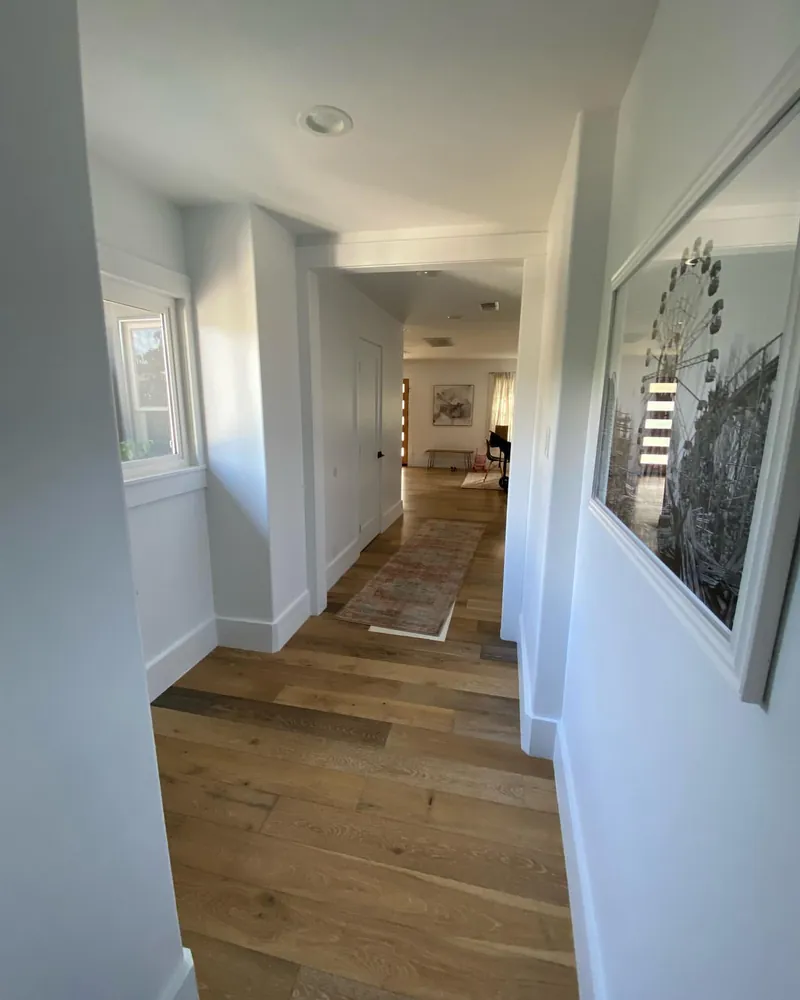
How We Repair Drywall Before We Paint
- Mark everything. We walk each room with you and mark every repair so the estimate lists them.
- Protect the room. Floors covered, furniture moved or wrapped, sanding dust kept to the work area.
- Repair in thin coats. Compound goes on in several thin coats with drying time between, which keeps repairs flat instead of humped.
- Match the texture. We test on a scrap piece first, then feather the texture into the wall.
- Prime the repairs. Every patch gets primer so the finish paint absorbs evenly.
- Paint wall to wall. Full walls, corner to corner, so no edge shows where new paint meets old.
- Walk through together. You check the walls in daylight before final payment.
Wall Textures We Match, Compared
A repair has to match the texture around it to blend in. Here is how the common finishes compare.
| Finish | What it looks like | How we match it |
|---|---|---|
| Orange peel | Fine, even bumps like the skin of an orange | Sprayed in light passes until the spatter size matches |
| Knockdown | Flattened splotches with smooth valleys between them | Sprayed heavier, then flattened with a wide knife |
| Hand texture | Irregular skip trowel or swirl pattern | Applied by hand to follow the pattern, the hardest to blend |
| Smooth | Flat, no pattern | Feathered wide and sanded, or skim coated when side lighting is strong |
Smooth walls are the least forgiving. The Gypsum Association's GA-214 finishing standard recommends its top level, Level 5, which adds a skim coat over the entire surface, where non-flat or deep-tone paints are used or where strong side lighting hits the wall. With bright window light, we will tell you whether spot repairs or a skim coat makes more sense.
What Drives the Cost of Drywall Repair in a Paint Job
Because drywall repair before painting in Simi Valley is part of our painting estimate, you see each repair as a line item rather than a vague prep charge. Cost depends on:
- Number and size of repairs. A dozen nail holes is a different job from three doorknob holes and a cracked seam.
- Texture. Knockdown and hand textures take longer than orange peel; smooth walls may need a skim coat.
- Location. Ceiling and stairwell repairs need more setup than walls at eye level.
- Water damage. Soft drywall from an old leak has to be cut out and replaced, and the leak must already be fixed.
- Drying time. Deep fills and new tape need time between coats, which affects the schedule.
Drywall Repair Before Painting in Simi Valley: Why Walls Crack Here
The magnitude 6.7 Northridge earthquake of January 17, 1994 buckled freeway support columns under the Simi Valley Freeway, and smaller quakes have rattled the area since. Census estimates put the median Simi Valley home's construction year at 1979, so most walls here have had decades of settling and patching.
Seasonal swings between dry Santa Ana conditions and winter rain also make wood framing shrink and swell, which shows up as nail pops and seam cracks. Good drywall repair before painting in Simi Valley deals with those causes, not just the marks. If a crack keeps widening or doors start sticking, we will point it out so you can have it checked before we cover it.