House painting in West Covina mostly means postwar tract houses, and a great many of them. The city's 2019 historic context statement counts more than 20,000 residential properties built between 1945 and the end of the 1970s, on land that had been walnut and orange groves.
Best Top Painting drives in from Simi Valley and has painted homes since 1988. At the estimate we walk all four sides, note which walls are stucco and which are wood, and write the prep and price line by line before anything is scheduled.
Tract Houses, Valley Heat and Winter Rain
According to the 2019 context study, tracts of the late 1940s and 1950s were usually one-story Minimal Traditional, Mid-Century Modern or Ranch houses clad in stucco or wood, typically horizontal or vertical clapboard, sometimes trimmed with stone or brick. Houses from the late 1960s and 1970s lean toward stucco with wood, stone or brick accents. Regional housing figures date 37.9 percent of the city's homes to the 1950s and 55.8 percent to before 1970.
That age shows up in the paint. Clapboard recoated for decades builds thick layers that split along board edges, and old stucco collects hairline cracks and patches in mismatched texture. A new coat over a failing one peels right along with it.
The valley's hot-summer Mediterranean climate brings 88°F August highs next door in Covina, and the nearest NOAA station logs about 16.7 inches of rain a year, mostly in February and January. We start sun-facing walls early in summer and save the wettest winter weeks for interiors.
From Sunkist Village to the San Jose Hills
Sunkist Village, opened in 1941 on the west side, was the city's first subdivision and appears in city surveys as a potential historic district. Postwar building then pushed east along Garvey Avenue, with a second early pocket of tracts below it around Vine and Lark Ellen avenues. On these blocks clapboard and stucco often sit side by side, sometimes on one house.
From the late 1960s on, new building moved into the San Jose Hills to the south, with larger tracts on curving roads that opened up around Shadow Oak. Woodside Village, a master-planned community begun there in 1975, spans 2,300 acres shared with Walnut. Houses of that era are typically stucco with wood, stone or brick accents, so the work shifts toward crack repair and accent detail rather than siding.
House Painting in West Covina, Surface by Surface
Most tract houses here mix two or three exterior materials. One repaint often draws on several of these services.
Stucco Repaints for 1950s Tracts
Stucco that has stood for seventy years has usually been patched more than once, and each patch can show through fresh paint as a flat or rough spot. We clean and fill hairline cracks, match the surrounding texture, and spot-prime every repair so the wall reads as one surface. With our stucco repair and painting, walls with active cracks may get an elastomeric coating, while sound walls usually stay with a breathable acrylic.
Clapboard Siding and Wood Trim
Horizontal and vertical clapboard is common on the early postwar tracts near Garvey Avenue and around Vine and Lark Ellen. Wood swells and shrinks with heat and moisture, so we scrape loose paint, sand edges smooth, caulk open joints and prime bare boards before two finish coats. Soft boards or fascia get flagged at the estimate and fixed as prep within our exterior house painting.
Interior Painting for One-Story Ranch Houses
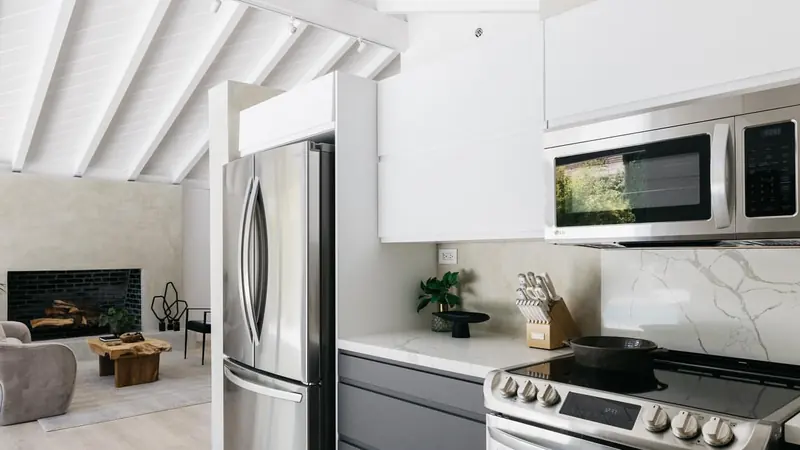
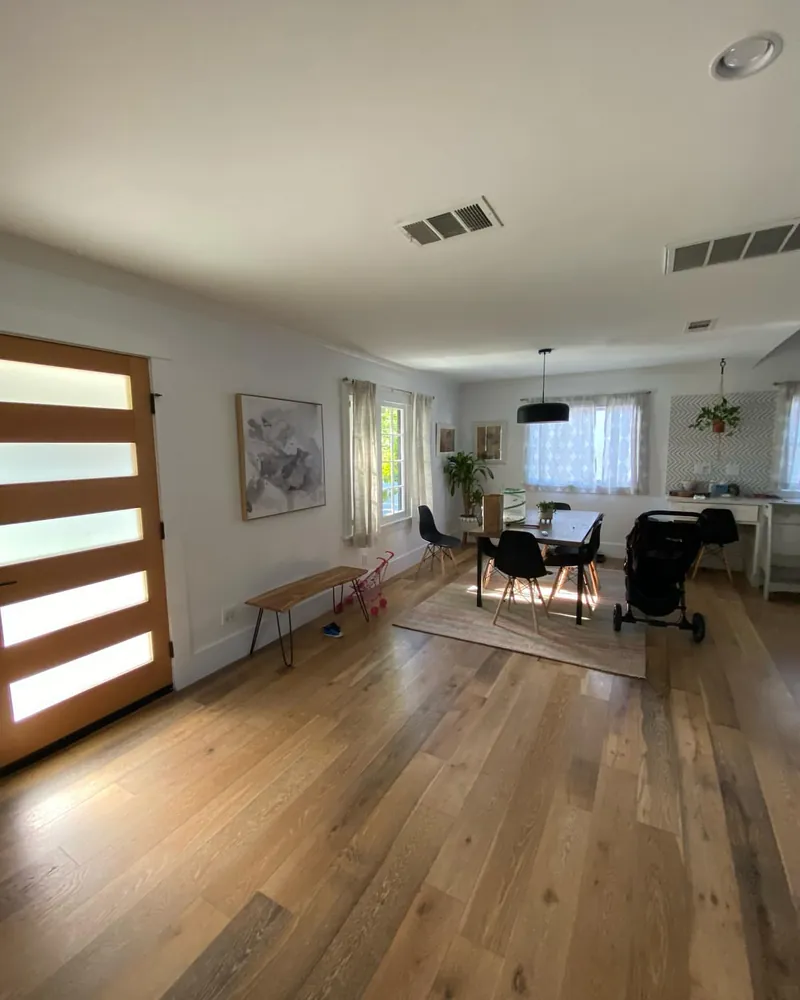
A one-story Ranch or Minimal Traditional plan often runs the living room, hall and bedrooms together, so wall colors and sheens need to flow from space to space. We patch nail pops and old anchor holes, sand, and cut straight lines at ceilings and baseboards. Our interior house painting can take on a single bedroom or the entire floor plan.
Cabinet Painting in Postwar Kitchens
When the cabinet boxes in an older tract kitchen are still sturdy, painting them can stand in for replacement. We remove and label the doors, degrease every surface, sand, apply a bonding primer and spray the finish so it lays down without brush marks. Cabinet painting gives a 1950s or 1960s West Covina kitchen a new color while the original boxes stay put.
Color Consultation for Mid-Century Exteriors
A low Ranch roofline with stone or brick accents, or a Mid-Century Modern front with strong horizontal lines, looks best when body, trim and accent colors are picked together. We brush large sample patches on the house so you can judge them in morning and afternoon light. Color consultation is available on request and handled case by case.
West Covina Permits, Preservation and Fire Maps
The Building Division of the Community Development Department, at 1444 W. Garvey Avenue S., handles plan review, permits and field inspections. Applications go through the One Stop Building Permit Center portal or the in-person counter. Whether a project needs a permit is the division's call, so check with them before replacing siding or stucco.
The city's 2007 preservation ordinance allows landmarks and historic districts only with owner consent, and West Covina has no separate preservation commission. On the State Fire Marshal's March 24, 2025 recommended maps, just 47 acres of the city are Very High, down from 1,136 on the 2011 map. In mapped zones, California's Wildland-Urban Interface Code (Title 24, Part 7) has set the rules since it replaced CBC Chapter 7A on January 1, 2026.