Good house painting in Covina starts with knowing which era a home belongs to. Regional housing data place 41.2 percent of Covina's homes in the 1950s and 66.3 percent before 1970, while a much smaller group of Craftsman bungalows and Folk Victorian cottages near downtown dates to the early 1900s.
We come over from Simi Valley and have painted homes since 1988. Each estimate covers every side of the house in writing, with prep listed apart from paint, and the final payment waits until you have walked the finished job.
Orange Groves, Postwar Houses and Valley Summers
Covina was founded in 1884, and by 1907 it claimed to be the third-largest orange shipping point in the world. After World War II the groves were steadily replaced by houses, and the 1950s produced more of today's homes than any other decade, with the 1960s adding another 16.8 percent. Most of those houses are now around seven decades old, an age when hairline cracks, chalking and patched surfaces become common.
The city sits at about 560 feet with a hot-summer Mediterranean climate. August highs average 88°F and January highs about 60°F, and most of the 16 to 18 inches of yearly rain falls in January and February. Long dry summers fade south and west walls fastest, so those sides often get the most prep.
On wood homes from the early 1900s, paint lifts at board ends and window sills, and soft spots can hide under old coats. We probe trim and siding before pricing anything.
Cottage Drive, Italia Street and the Blocks Near Citrus Avenue
Old Town centers on Citrus Avenue, the downtown main street, with the 1911 Firehouse Jail Museum behind City Hall. Just west of Citrus, the single block of Cottage Drive and Orange Street was recommended in a 2007 survey as a potential historic district. It holds 13 contributing one-story homes, ranging from Folk Victorian to Craftsman, that keep their original platting and scale.
On E. Italia Street, the same survey singled out several Craftsman bungalows and a 1929 Spanish Colonial Revival house as potential individual landmarks, and W. Orange Street has Craftsman examples from 1909 to 1929. Beyond the old core, most housing is postwar, and we confirm each home's wall materials at the estimate.
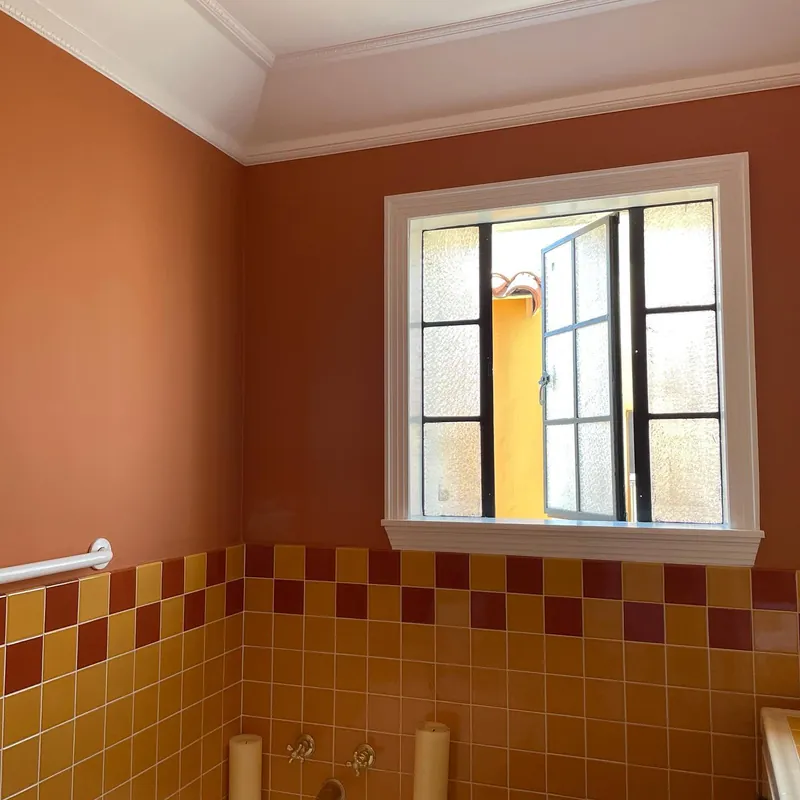 After
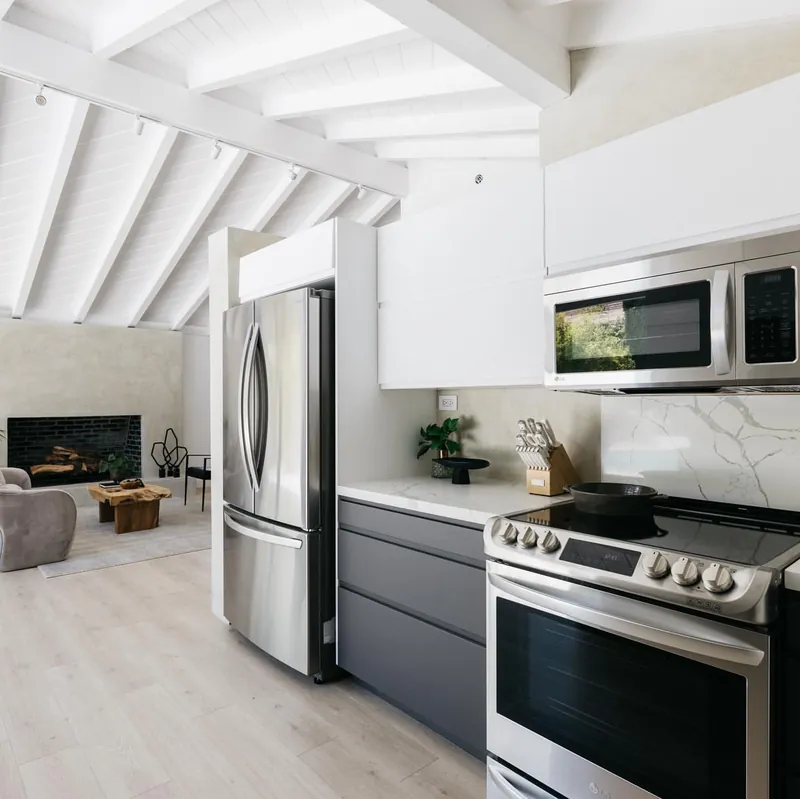
What House Painting in Covina Involves
Covina's housing splits between a small set of pre-1930 wood homes and a large stock of 1950s and 1960s houses. The services below are matched to both.
Craftsman and Folk Victorian Exteriors
Turn-of-the-century cottages on Cottage Drive and Craftsman bungalows on Italia Street carry a lot of wood: siding, porch posts, window casings and rafter ends. We hand-scrape loose paint, sand to a feathered edge, caulk open seams and prime bare wood before the finish coats, picking out trim in its own color where the style suits it. Our exterior house painting is built around that slow, detailed prep.
1950s Stucco Refresh
Where a Covina house from that decade has stucco, about seven decades of sun usually leave fine cracks and chalky color. We wash the walls, fill and texture each crack, and spot-prime repairs so they stay hidden under the new coat. Through our stucco repair and painting, we recommend elastomeric for walls that keep cracking and a breathable acrylic where the stucco is stable.
Dry Rot Repair as Paint Prep
Wood exposed for a century or more can soften at sills, porch boards, fascia and the lower edges of siding, where water sits. We probe suspect spots during the estimate, then fill small areas with epoxy or replace short sections before priming, always as part of painting the house. Our dry rot and trim repair keeps fresh paint from sealing over decay.
Interior Walls and Trim
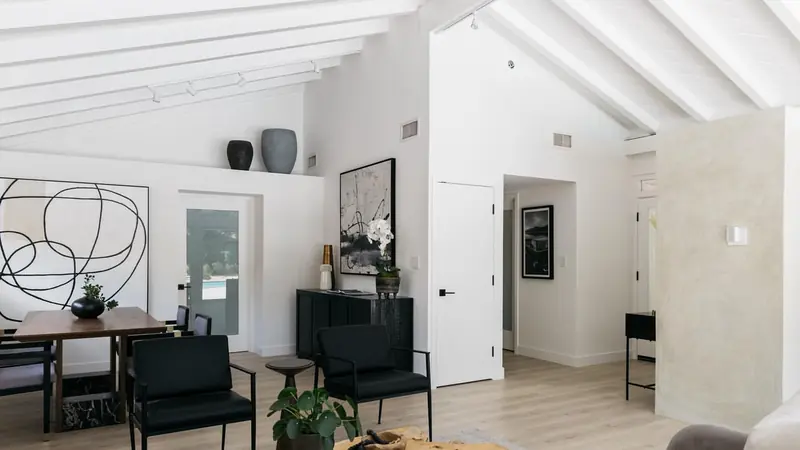
Older Covina homes often keep original door casings, baseboards and built-ins under many coats of paint, while postwar houses tend toward plainer trim and textured walls. We fill dents, scuff glossy trim so the new coat bonds, patch wall damage, and cut clean lines where wall meets woodwork. Our interior house painting handles one room or the whole house.
Cabinet Painting for Older Kitchens
In a kitchen that has been in use for decades, the cabinet boxes may still be solid even when the finish is worn through around the pulls. We take off and label the doors, degrease, sand, apply bonding primer and spray the finish for a smooth, even surface. Cabinet painting changes the room's color without tearing out cabinets that still work.
Covina Permits, Preservation and Fire Zones
The Building and Safety Division, part of Community Development at City Hall, 125 E. College Street, processes permits for Covina addresses only. Express permits for simple like-for-like work are issued over the counter, while exterior modifications go to building plan check after Planning Approval. If your project reaches beyond paint, such as new siding or windows, ask the division which path applies.
Covina's 1997 preservation ordinance requires owner consent for landmarks, and the LA Conservancy reports that none have been designated, so Cottage Drive remains a survey recommendation. The State Fire Marshal's March 24, 2025 recommended maps show no Very High acreage in Covina, compared with 165 acres on the 2011 map, and just 7 acres in High. Wherever a parcel is mapped, California's Wildland-Urban Interface Code (Title 24, Part 7) now applies, having replaced CBC Chapter 7A on January 1, 2026.