Hiring a roofing contractor in Thousand Oaks means working under a local roof rule: Thousand Oaks amended its building code to raise the required roof covering from Class B to Class A. Add a housing stock that peaked in the 1970s and a General Plan that places most of the city in a Very High Fire Hazard Severity Zone, and reroof decisions here carry real weight.
Best Top Roofing drives over from Camarillo to inspect, repair and replace roofs across the Conejo Valley. Each job starts with a free inspection, photos of every problem and a written summary before anyone talks price.
What Conejo Valley Weather Does to a Thousand Oaks Roof
The valley floor sits at about 900 feet, ringed by the Santa Monica Mountains, Conejo Mountain and the Simi Hills. Mean highs run from about 67 degrees in winter to 91 in August, with January lows near 36.
Rain comes in a narrow window: about 17.35 inches a year, with January and February each delivering just over four.
The General Plan says strong, dry northeasterly Santa Ana winds fueled the 2018 Woolsey Fire, and gusts like those lift shingle edges and push embers into vents. Marine air slipping through the passes keeps the west side cooler, with Newbury Park summer highs near 80 degrees.
From the Central Valley Floor to North Ranch and Lang Ranch
Thousand Oaks spread outward from US 101 and Moorpark Road in the 1950s and 1960s, so its oldest housing clusters around the SR-23 and US 101 interchange and in Newbury Park.
Later neighborhoods came through master plans: the Thousand Oaks side of Westlake, annexed in 1968 and 1972, North Ranch in 1973, and specific-plan areas such as Lang Ranch, Rancho Conejo and Rancho Potrero. North Ranch borders 2,595 acres of open space and Lang Ranch preserves 863, so edge lots there face brush and get extra attention at vents, eave ends and gutters.
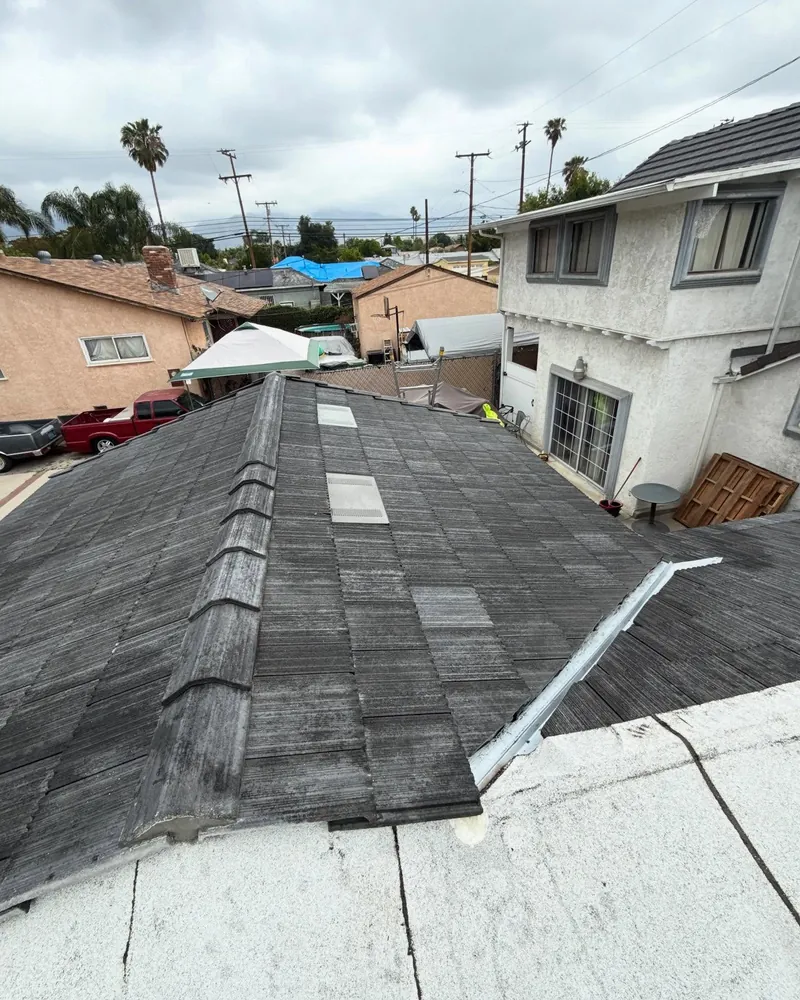
Services We Offer as a Roofing Contractor in Thousand Oaks
A citywide Class A rule and a 1970s building peak set the agenda for most Thousand Oaks roofs.
Class A Amendment Reroofs for City Addresses
Because Thousand Oaks raised its required roof covering from Class B to Class A, every reroof at a city address uses Class A materials, whether tile, shingle or metal. With most of the city mapped as a Very High Fire Hazard Severity Zone, we add ember-resistant vents and closed eave ends to the fire-resistant roofing scope on hillside and open-space lots.
1970s Decking Replacement in the Older Core
A third of the city's homes went up in the 1970s, so a house from that peak is now 45 to 55 years old. A roof replacement is the only time original decking and attic ventilation are fully exposed, and the tracts near the SR-23 and US 101 interchange are the likeliest to need boards replaced.
Chimney and Skylight Flashing Leaks From the Valley's Temperature Swings
The swing from near-freezing January nights to 90-degree August afternoons works roofing materials every year, and sealant at pipe boots and flashing tends to split first. When a stain appears, our roof leak repair follows the water to its entry point, often wall, chimney or skylight flashing, rather than sealing over the stain.
Gutter Guards Under Oak Canopies, Added With a New Roof
Where an oak overhangs the house, its leaves end up in valleys and gutters, holding water in winter and giving embers a foothold in fire season. When we replace a roof, we can fit new gutters with guards as part of the same job. Cutting, removing or relocating any oak takes a city Protected Tree Permit, so ask the city first.
Free Inspections Booked Ahead of January
A free roof inspection checks the covering, flashing, vents and attic, and you keep the photos and written findings whatever you decide. A cracked tile can stay dry for months and then leak in the first heavy storm, so we suggest booking before the January rains rather than after them.
Woolsey, Hill and the City's Fire Hazard Zones
Two fires broke out on November 8, 2018. The Hill Fire started at Hill Canyon Road and Santa Rosa Road, about a mile west of the city, and burned 4,381 acres. The Woolsey Fire grew to 96,949 acres across two counties and destroyed 1,643 structures, and the General Plan says that in Thousand Oaks it damaged or destroyed dozens of properties and temporarily displaced hundreds of residents.
That plan maps Very High Fire Hazard Severity Zones over a majority of the city, leaving out only the denser core.
Thousand Oaks Permits, the Class A Amendment and Oak Trees
For city addresses, the Thousand Oaks Building Division at City Hall issues reroof permits, with inspections, status and records on the TO/24 portal. We file the application.
Casa Conejo, Ventu Park, Rolling Oaks and Lynn Ranch are county islands, so Ventura County issues permits there and the city's amendments do not govern. We confirm jurisdiction before writing a proposal.
On January 1, 2026, the state's wildfire construction rules moved to a code of their own, the California Wildland-Urban Interface Code (Title 24, Part 7). Where a lot falls inside a mapped hazard zone, roofing applied during a repair must also be Class A.