A roofing contractor in Bellflower works from a detailed city re-roof handout, last revised July 27, 2026. It requires a permit for more than 300 square feet of roofing, Planning approval for any change of material or color, and a Class B or better covering on every re-roof.
Our crews travel from Camarillo, and the Bellflower inspection is free. We photograph the problem areas, explain which handout rules apply to your house and give you a written, itemized proposal.
From Somerset Ranch Farms to Postwar Tracts
Bellflower, one of the Gateway Cities, began as Somerset Ranch, 1,000 acres split into one-acre farms, and took its name from the 1909 post office. After the war, soaring property values pushed most farmers east, and the farms became large housing subdivisions.
The Housing Element dates 32.4 percent of homes to the 1950s and 26.6 percent to the 1960s, and it notes that homes over 30 years old may need major work such as a new roof. Lots are small, with a median of 0.16 acre.
Water shaped the city. The San Gabriel River once flooded the area each year, running down what is now Bellflower Boulevard, until 1947 improvements cut the risk. Today nearly the whole city sits in the Special Flood Hazard Area behind a levee, and all of it lies within the Whittier Narrows Dam inundation zone, where a failure would bring about 4 feet of water within 15 hours.
Overhead, the concern is rain: the Long Beach Airport station, about 5 miles off, logs 12.02 inches a year and peaks in February. The Puente Hills Blind Thrust runs directly beneath the city, and shaking is the main earthquake threat.
Downtown, the Old Rail Line and the North and South Tracts
Downtown grew along Bellflower Boulevard, a shopping street that stayed busy into the late 1960s, before the mid-1970s Artesia Freeway split the core in two. The Pacific Electric Santa Ana Line ran through town from 1905 until its last train in 1958.
Aerials from 1952 and 1953 show large tracts already filling the south side, while in the north tracts later replaced farms, so houses there can run a little younger. Storm drain deficiencies explain the one designated flood hazard area, a mostly residential pocket below Alondra Boulevard on the west side of Lakewood Boulevard.
Along the east edge, the San Gabriel River runs in a channel built for a 100-year flood. The city has also encouraged splitting larger estate and farm parcels for new single-family homes, so a newer house can sit beside a 1950s one.
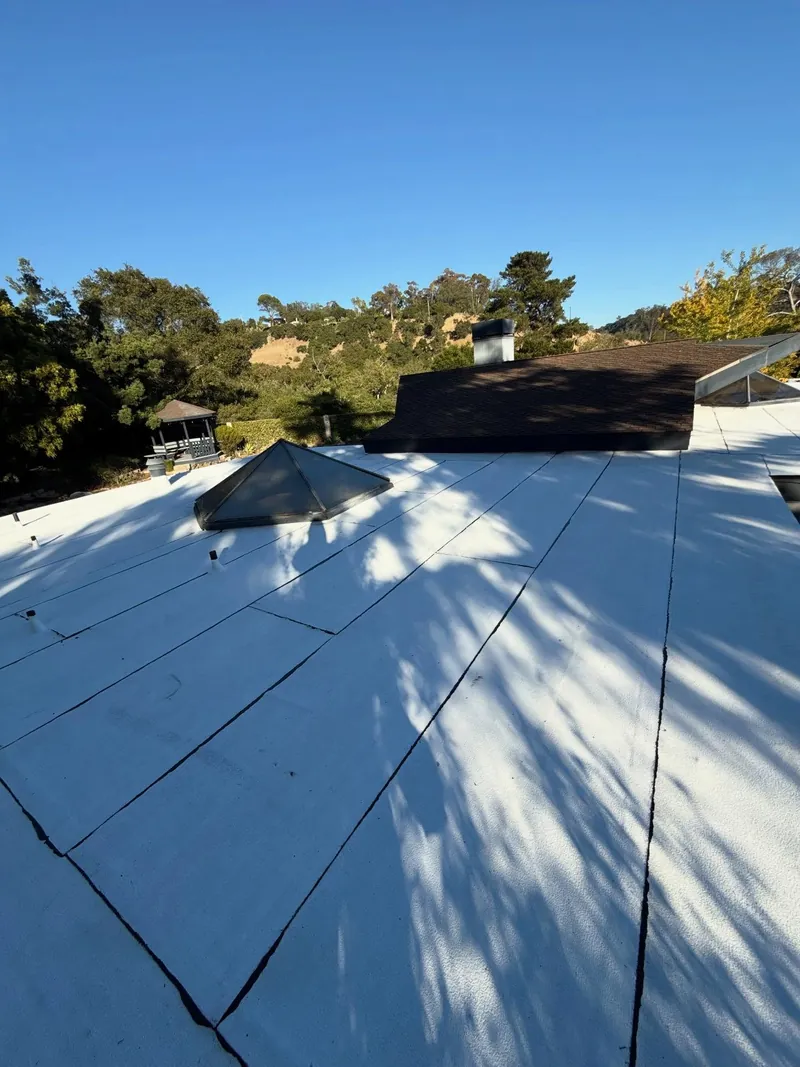
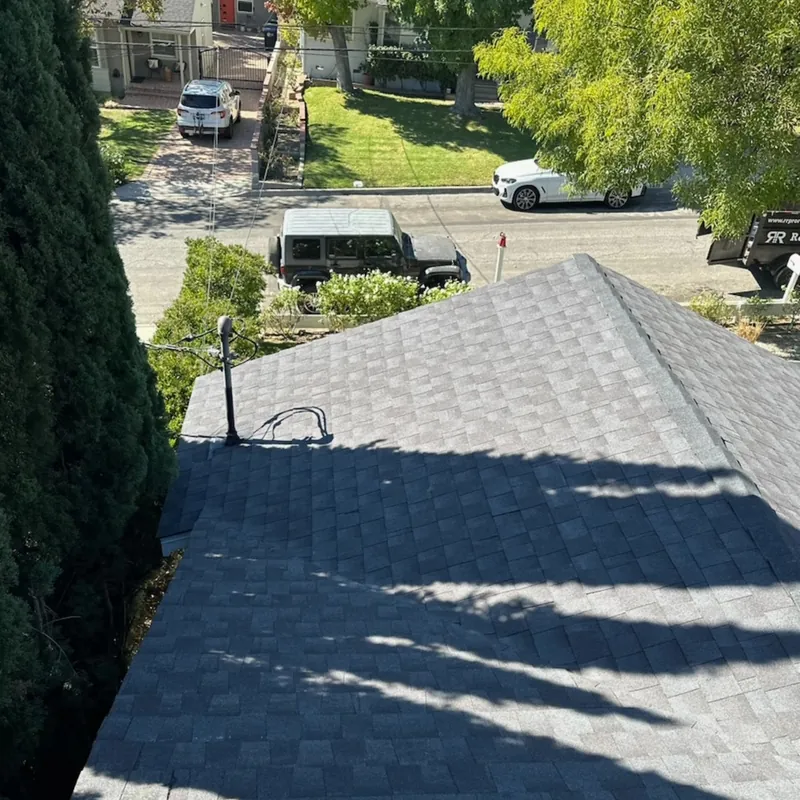 After
How a Roofing Contractor in Bellflower Meets the Handout
The city's re-roof handout reads like a checklist. Each item below maps to a service and links to its full page.
Material and Color Approvals for Tile Conversions
Any change in roofing material, including its color, must be reviewed and approved by Planning. A switch from shingles to tile roofing is one such change, and the handout requires no engineering for lightweight tile up to 5.9 pounds per square foot. We bring samples to the inspection and list the current and proposed material and color in the proposal for Planning.
Class B or Better Coverings, With Class A Options
Every re-roof in Bellflower needs a Class B or better covering, even though the city has no recommended fire hazard zones. Many asphalt shingle and tile products carry a Class A rating, which exceeds that floor. Our fire-resistant roofing proposals name the rating of each product so the counter can see it meets the rule.
Overlay Limits and Full Tear-Offs
The handout allows no more than one asphalt shingle overlay over an existing asphalt roof, and none over water-soaked or deteriorated roofing. A house that already carries an overlay therefore needs a full roof replacement down to the sheathing next time. We count layers and probe for soft decking during the free inspection.
Sheathing Pre-Inspections Before Anything Is Covered
Bellflower inspects re-roofs twice: a pre-inspection of the sheathing and delivered materials, with ventilation and flashings in place, then a final. Anything covered before that first visit must be uncovered at the contractor's expense, so we book it as soon as the deck is exposed. Our own free roof inspection beforehand estimates how much sheathing may need replacing.
Low-Slope Underlayment on Shallow Pitches
Asphalt shingles need at least a 2:12 slope here. From 2:12 to 4:12 the handout calls for two underlayment layers, and one layer at 4:12 or steeper. We measure every plane before pricing shingle roofing, and anything flatter than 2:12 gets a low-slope system instead.
Permits, Planning Review and the July 2026 Handout
Replacing or repairing more than 300 square feet of roofing needs a permit, which Building and Safety at City Hall, 16600 Civic Center Drive, usually issues over the counter for homes. Work follows the 2025 California Building Codes, with attic ventilation per CRC R806 or CBC 1202.2.
Plan submittals go to Planning first, then to Building and Safety with the Planning assignment sheet, and residential reviews take 10 business days. Smoke alarms are required whenever a building permit is, though carbon monoxide alarms are not when the work is limited to the roof covering.
The State Fire Marshal's March 2025 recommended maps leave Bellflower without any Fire Hazard Severity Zone. The Wildland-Urban Interface Code (Title 24, Part 7), which replaced CBC Chapter 7A on January 1, 2026, therefore has little say here, and the city's own Class B floor sets the fire rating.