Most work for a roofing contractor in Lakewood traces back to a three-year building sprint. Between 1950 and 1953, builders put up roughly 17,500 homes with two or three bedrooms on old farmland, framed with rafters and topped with red cedar shingles. The city incorporated in 1954 and is now fully built out, so nearly every roof job here is work on an existing house.
Best Top Roofing drives in from Camarillo to inspect Lakewood roofs for free. We photograph what we find, explain what has changed since the original build and hand you an itemized written proposal.
Cedar Shingles, Rafter Frames and a 7½-Minute Pace
Ground was broken on roughly 3,450 acres in February 1950, and crews soon finished a house about every 7½ minutes. Materials arrived pre-cut, about 4,000 workers moved along each street on a set schedule, and a truck-mounted conveyor lifted shingles straight onto the roofs.
Those first roofs were red cedar shingles over rafter frames. More than 70 years on, the covering on a given house may be its second or third, so we never assume what is up there. The city still links county permits issued since 2008, which can show recent work.
The SCAG profile dates 54.6 percent of homes to the 1950s and 83.7 percent to before 1970, and 82.4 percent are single-family detached houses. Many owners expanded instead of moving, so plenty of original roof lines now meet later additions.
Lakewood is one of the Gateway Cities of southeast Los Angeles County, and the Long Beach Airport station about 3 miles away records 12.02 inches of rain a year. February is the wettest month, while July through September each bring less than a tenth of an inch. The nearest active fault, the Newport-Inglewood, runs about 3 miles southwest.
Lakewood Park, Mayfair and the Older Tracts
Lakewood Park was the first phase, and an estimated 30,000 people lined up when its sales office opened on March 24, 1950. Lakewood Mutual Homes and Carson Park, a Lakewood tract name rather than the neighboring city, followed as the second and third phases.
Some streets predate the big build. Lakewood Gardens, begun in 1946, holds just under 500 homes between Lakewood Boulevard and Hayter Avenue, and most Lakewood Country Club Estates homes went up from 1936 to 1960, so their framing can differ from the mass-built phases.
Mayfair, nicknamed Radio Park for its street names, runs from Ashworth Street to South Street between Lakewood Boulevard and Woodruff Avenue. The city's manual also flags Tracts 11600 and 12673 for special porch projection limits.
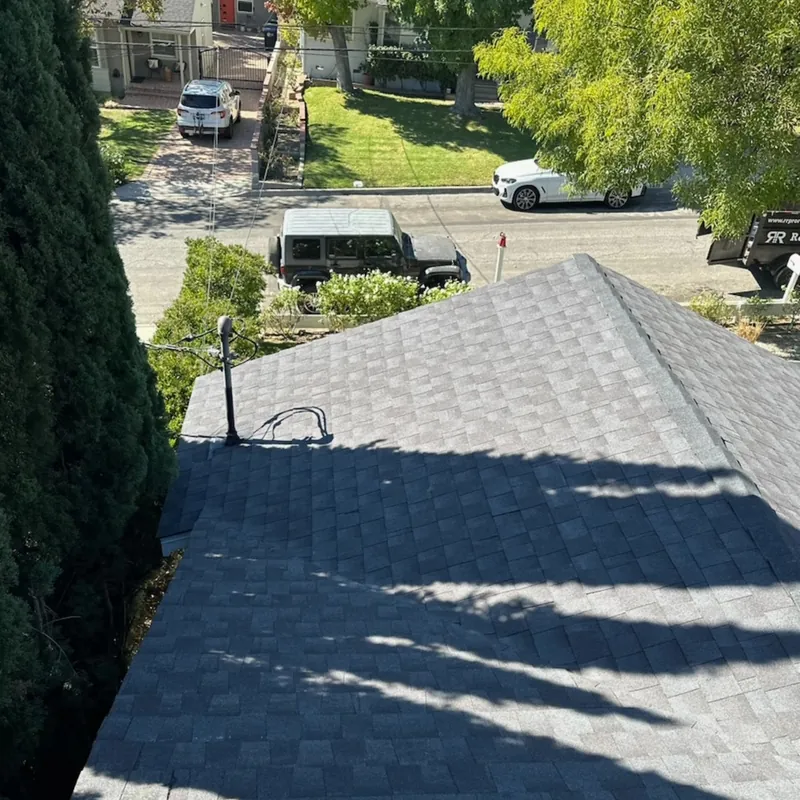 After
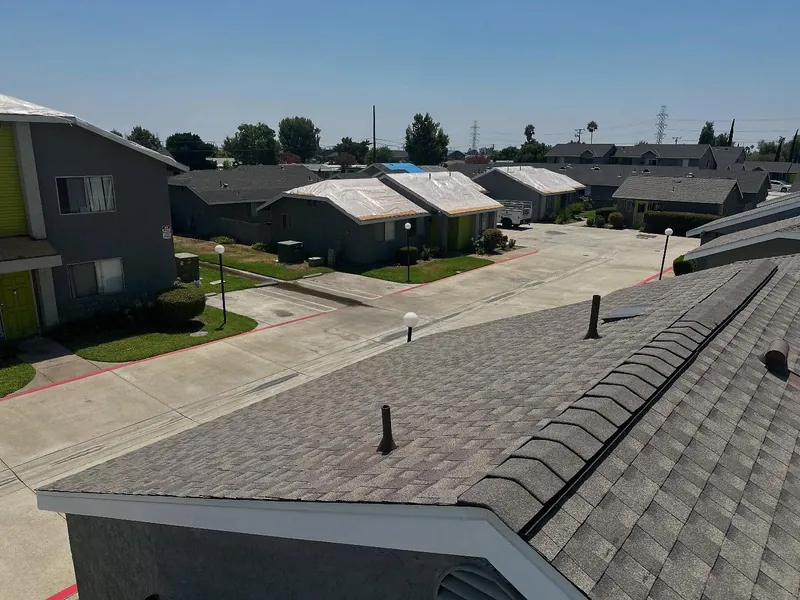
Work We Do as a Roofing Contractor in Lakewood
Matching tracts do not mean matching roofs after so many additions and re-roofs. These five services cover most of it, each linked to its full page.
Cedar Shingle Replacement on 1950s Tract Houses
Where red cedar is still on a house, or sits under a later layer, a complete tear-off is the clean fix. Our wood shake roof replacement work strips the old wood, checks the rafters and decking, and installs a modern covering in a profile that suits the original lines. We photograph the framing before it is covered.
Matched Pitch and Eaves for Every Unit on the Lot
Lakewood's residential manual says all dwelling units on a lot must match in roof style, vents, pitch, ridges, eaves and overhangs. When a second unit shares the lot, we plan shingle roofing so both buildings get the same asphalt shingle color, ridge treatment and vents. Roof-mounted equipment stays low profile, screened and painted to blend with the roof.
Addition Tie-In Flashing Where Houses Grew
The seam where a newer roof meets the original one is a common weak point on expanded Lakewood homes. During roof repair visits we check valleys, step flashing and kick-out flashing at those joints. When an addition was framed at a different pitch, we rebuild the transition so water has a clean path off both planes.
Dry-Season Leak Repair Before February Storms
With almost no rain from July through September, late summer is the easiest time to trace a ceiling stain to its source. A roof leak repair visit follows the water to the entry point, often a cracked pipe boot or tired flashing, and fixes it on a dry deck. Mid-winter leaks get priority during business hours.
Free Inspections With a Permit History Check
Before we climb up, we can look at which permits are on file for your address. The free roof inspection then covers the covering, flashing, vents and attic, with a photo of each problem area. You get a written summary that works for a sale, a purchase or a talk with your insurer.
Building and Safety, TRB+ Associates and the City Manual
Re-roofs in Lakewood start with a Building and Safety permit rather than planning review, and applications, permits and inspection requests run through the city's OpenGov portal. Building and Safety at City Hall, 5050 Clark Avenue, now relies on the private firm TRB+ Associates for plan check, permitting and inspection support.
That handover is recent. The city's manual, revised in March 2025, still described a county contract for plan check and inspections, and draft minutes show the Council approved agreements with TRB+ Associates and Bureau Veritas on June 23, 2026.
The manual also requires roofs to be continuously maintained. With no recommended Fire Hazard Severity Zones and a hazard plan that rates wildland fire risk as nonexistent, the Wildland-Urban Interface Code (Title 24, Part 7), which replaced CBC Chapter 7A on January 1, 2026, rarely shapes a Lakewood re-roof.