Hiring a roofing contractor in Long Beach often starts with a question about the address, not the shingles. More than 7,000 properties sit inside the city's 18 historic districts, the coastal zone runs between the Los Angeles and San Gabriel rivers, and express permits are off the table in both.
Best Top Roofing comes from our Camarillo base to inspect Long Beach roofs at no charge. You get photos, an itemized written proposal and a plain answer on which city reviews apply before anything is ordered.
Prewar Bungalows, Postwar Tracts and Shifting Ground
Long Beach built most of its houses early. The SCAG profile counts 70 percent of homes from before 1970, and the California Earthquake Authority puts the average residential construction date at 1953.
Those houses carry their own roofs. The city's historic re-roof application pairs clay tile with Spanish, Mission and Mediterranean homes, slate with Tudor, tar and gravel with Ranch designs, and original wood shingles with Victorian and Craftsman houses, where composition shingles are now the preferred substitute.
The ground matters too. The 1933 earthquake, centered offshore on the Newport-Inglewood Fault, dropped water tanks through roofs and knocked houses off their foundations, and that fault still runs beneath the city. Oil and gas pumping from the Wilmington Oil Field also left a subsidence bowl centered on the Port that reached 29 feet, which raises flood and erosion risk along the low shoreline.
Long Beach Airport averages 12.02 inches of rain annually, with December through March delivering 81 percent of the total. Summer fog usually burns off by afternoon, and August highs there average about 83 degrees.
California Heights, Belmont Heights, Naples and Los Altos
California Heights is the largest historic district, with nearly 1,500 homes from the 1920s, most of them Spanish Colonial Revival. The Wrigley Area adds Spanish Colonial cottages built from 1928 to 1934, so clay tile work dominates both.
Belmont Heights leans Craftsman, with bungalows making up about two-thirds of its homes, most built from 1918 to 1923, alongside Victorian, Mission Revival and Tudor Revival houses. Rose Park is mostly bungalows too, and Bluff Park lines Ocean Boulevard with large two-story Craftsman and Period Revival homes.
Naples is three flat, fully built islands where most inland lots are mapped special flood hazard areas, and the Peninsula sees recurring King Tide flooding. Inland, Los Altos grew from farmland into a postwar community of 10,000 homes, while new subdivisions spread across North Long Beach and Bixby Knolls.
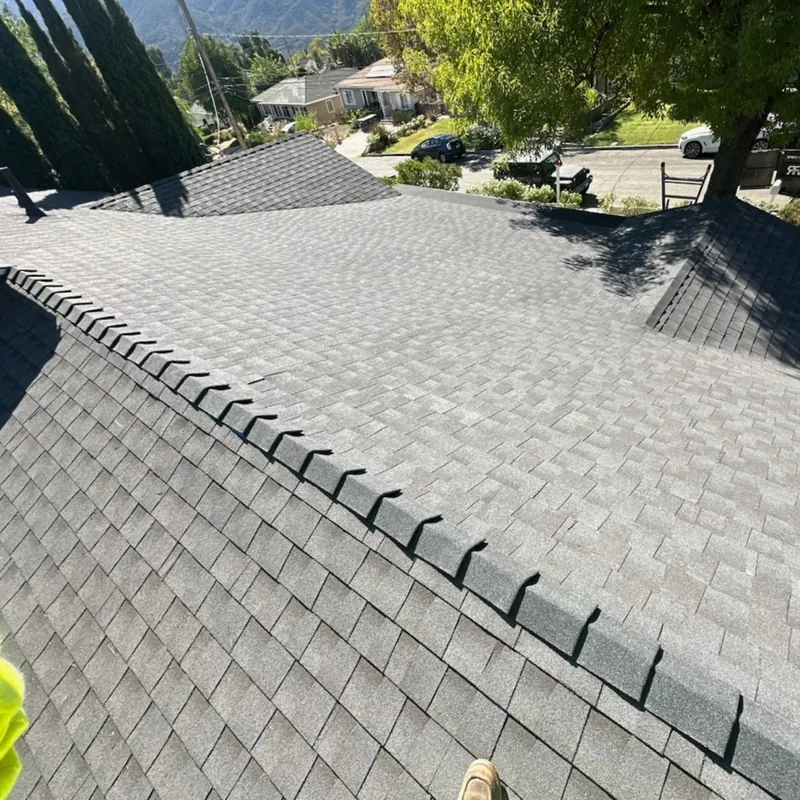 After
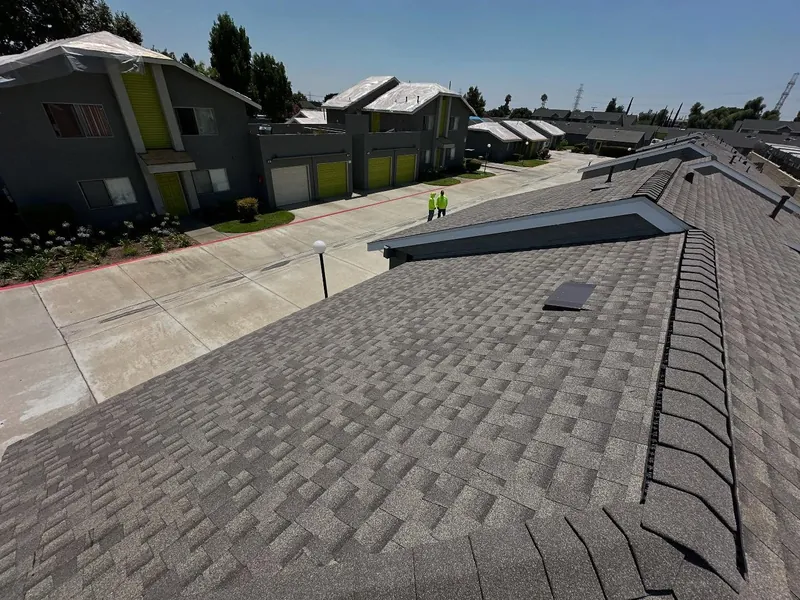
What a Roofing Contractor in Long Beach Handles Most
Historic review, coastal permits and an active fault shape most jobs here. Each of these five services links to its full page.
Historic District Shingle Reviews for Craftsman Bungalows
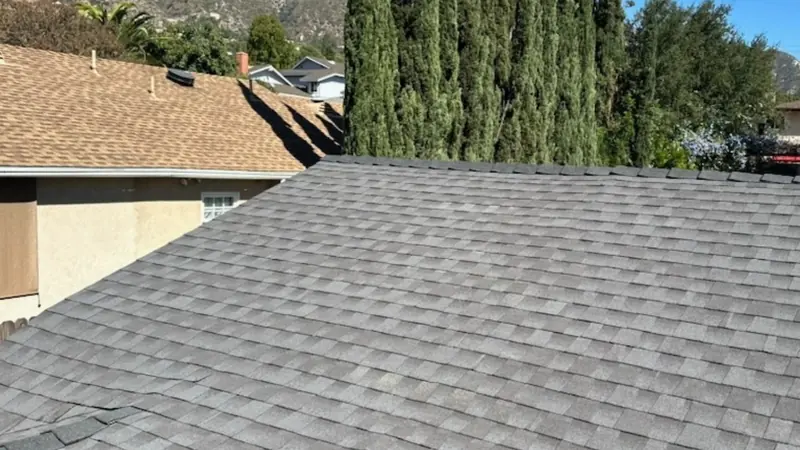
Re-roofing in any of the 18 historic districts calls for a free historic review of colors and materials. The city's application accepts dimensional composition shingles with a 30-year minimum but bars midnight and black. For a Belmont Heights or Rose Park bungalow we bring shingle roofing samples that already fit those limits.
Clay Tile Coping Reuse on Flat Sections
Where a flat roof in a historic district is edged with clay tile coping, the city requires that coping to be reused over the new torch-down or built-up system. Our flat roofing crews number and set aside each piece, renew the membrane and reset the original tile, with drip edges and downspouts finished to match the roof or trim.
Spanish Colonial Tile Repair in California Heights
Clay tile belongs on the Spanish Colonial homes of California Heights and the Wrigley Area. Tile roof repair there usually means resetting slipped pieces, matching cracked ones and resealing flashing at walls. Ordinary repairs that leave the exterior physically unchanged are exempt from a Certificate of Appropriateness, which keeps a true in-kind fix simple.
Coastal Zone Replacements in Naples and on the Peninsula
Express permits are not offered in the coastal zone, so a full roof replacement near Alamitos Bay goes through regular plan check. Coastal zone work also requires either a local coastal permit or a categorical exclusion before it begins. Since it is not always clear whether a like-for-like re-roof counts, we ask city planners up front and check King Tide dates before booking.
Earthquake Inspections Along the Newport-Inglewood Fault
The Newport-Inglewood Fault is considered capable of a magnitude 6.0 to 7.4 quake, and the 1933 shock centered on it destroyed about 70 schools. After any strong shake, a free roof inspection checks for cracked tile, shifted flashing and gaps at walls and parapets, with photos you can share with your insurer.
Permits, Historic Review and the Coastal Zone
Permits come from the Building and Safety Bureau at the Development Permit Center, City Hall, 411 West Ocean Boulevard. Since January 1, 2026, projects follow the 2025 California Building Standards Code plus the city's Title 18, and roofing up to 500 square feet on an existing building in any 12 months is exempt.
Outside historic districts and the coastal zone, express permits cover composition shingles over solid sheathing or one existing layer, up to 6 pounds per square foot. Inside a district, any exterior change needs a Certificate of Appropriateness before work starts, even when no building permit is required.
Long Beach has no recommended Fire Hazard Severity Zones on the State Fire Marshal's March 24, 2025 maps. The Wildland-Urban Interface Code (Title 24, Part 7), which replaced CBC Chapter 7A on January 1, 2026, therefore has little reach here.