Most calls to a roofing contractor in Claremont come from homes shaped by two things: the foothill fire map and the city's architectural review. The State Fire Marshal's March 2025 recommendations put 3,188 acres in the Very High zone, about 37 percent of the city, and the City Council approved that map on July 22, 2025.
Best Top Roofing travels from Camarillo to inspect, repair and replace roofs across Claremont. We start with a free inspection, photograph each problem, and write a proposal that lists every layer by name.
Postwar Growth, Foothill Winds and Summer Heat in Claremont
Claremont grew fastest after World War II, from 3,057 residents in 1940 to 24,776 in 1970. SCAG's 2019 profile reflects that boom, with 24.2 percent of homes from the 1950s, 24.0 percent from the 1960s and 61.6 percent built before 1970.
The city's 2022 hazard mitigation plan, cited in a 2023 city environmental report, places Claremont in the direct path of Santa Ana winds. Typical events push about 40 mph through passes and canyons with gusts near 57 mph, and stronger ones top 69 mph across wide areas, which is enough to peel shingles and snap ridge pieces. Summers sometimes pass 100 degrees, and the nearest NOAA station with temperature normals, Pomona/Fairplex about three miles southwest of the Village, logs about 70 days a year at 90 or above.
Claraboya, Padua Hills, Thompson Creek and Historical Claremont
Claraboya, Thompson Creek and Padua Hills are the northern foothill neighborhoods the 2002 Williams Fire threatened before its winds died down. A roof scope there usually begins with the fire map and the gusts coming off the mountains above the 1,740-acre Claremont Hills Wilderness Park.
The Historical Claremont district covers the city's oldest residential area, and its zoning asks that existing architectural materials be preserved in repairs. Memorial Park and Indian Hill Boulevard are lined with American elms, and wherever big street trees overhang a house, leaves collect in valleys and gutters before the rainy season.
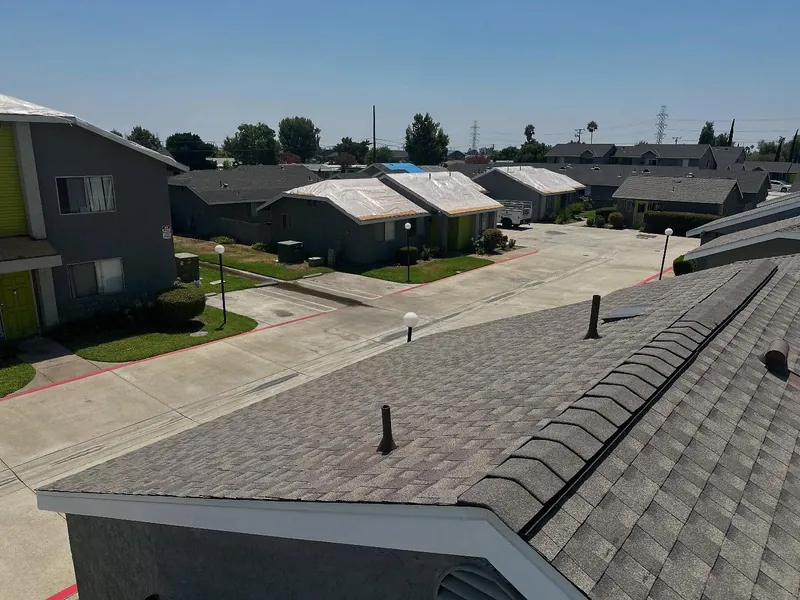
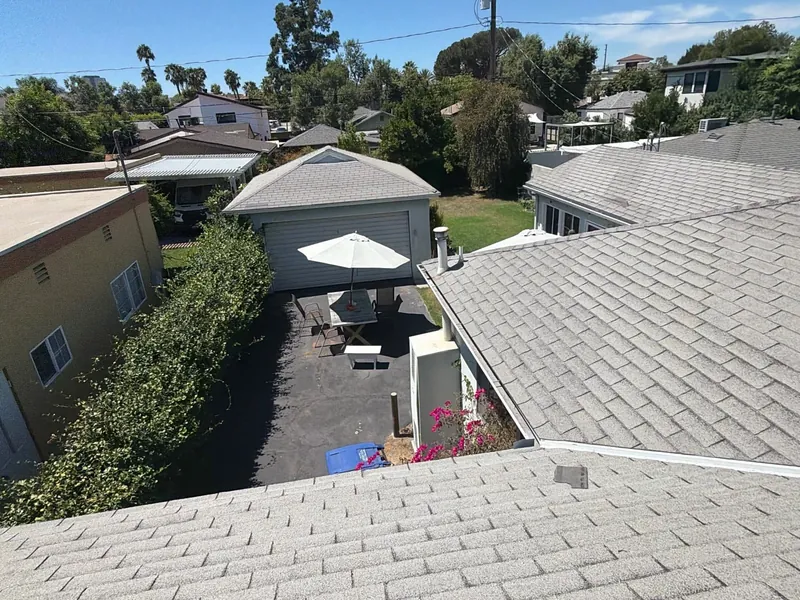
The 2003 Grand Prix and Padua Fires
The Padua Fire started on the afternoon of October 26, 2003, and burned 10,446 acres. Together with the Grand Prix and Old fires it formed a 40-mile front across the San Gabriel Mountains, and 71 homes in and around Claremont were destroyed or damaged, with an estimated $20 million in damage in the city.
Claremont's Very High acreage shrank on the 2025 recommendations, from 4,158 acres on the 2011 map to 3,188, with another 954 acres rated High. The city also posts a parcel-by-parcel version of the map.
Work We Take On as a Roofing Contractor in Claremont
Five services cover most Claremont projects. Each ties back to the fire map, the wind or the city's design rules.
Foothill Class A Coverings in the Very High Zone
In Claremont's mapped zones, roofs now fall under the Wildland-Urban Interface Code (Title 24, Part 7), which took the place of CBC Chapter 7A on January 1, 2026. Any covering used in a repair there must be at least Class A, and replacing 50 percent or more of a roof within 12 months triggers new-construction rules. Our fire-resistant roofing work pairs the covering with ember-resistant vents and closed eave gaps.
Santa Ana Wind Repairs and Emergency Tarping
When autumn gusts lift shingles, crack ridge pieces or drop limbs, the priority is keeping the next rain out. Call during business hours and an active leak moves to the top of our list for emergency roof repair and tarping, followed by a permanent fix. We photograph the damage before and after, which helps if you choose to talk with your insurer.
Replacements in the Historical Claremont and Arbol Verde Districts
In the HC and AV districts, exterior modifications to existing homes go to the Architectural and Preservation Commission when the Director finds a substantial adverse visual impact, and to staff when there is none. The code does not say whether a like-for-like re-roof counts, so we confirm with the city before scheduling a roof replacement. Because HC zoning asks for compatible new materials, we price a match to the current roof first.
Ember-Ready Gutters With a New Roof
Elm-lined streets and foothill brush both send debris toward gutters, and dry leaves in a trough give embers an easy place to land. When we replace a roof, we can add new gutters with guards tied into the drip edge. We add them only alongside a new roof or a major repair.
Free Inspections for 1950s and 1960s Homes
Nearly half of Claremont's houses date from the 1950s and 1960s, so many may still sit on original decking more than 55 years old. A free roof inspection checks the covering, flashing, vents and attic airflow, and you receive photos and written notes either way. Booking one before the fall wind season leaves time to fix weak spots.
Claremont Building Permits, Design Review and Fire Rules
The Building Division at City Hall, 207 Harvard Avenue, runs plan check, issues permits Monday through Thursday and processes work without plans over the counter. Projects with plan sets are submitted electronically.
Design review belongs to the Architectural and Preservation Commission under Chapter 16.300, which covers exterior changes but not painting. Exterior changes to single-family homes in the RS, RM, RR and H districts are reviewed by staff, though the Director may refer any project to the Commission. Properties listed on, or eligible for, a local, state or National Register also fall under the Cultural Resource Preservation ordinance.