Nearly half of Moorpark's homes went up in the 1980s, and that shapes almost every job a roofing contractor in Moorpark takes on. The population jumped from about 4,000 in 1980 to more than 25,000 by 1990, so a large share of houses are now about 40 years old, an age when flashing, underlayment and original coverings deserve a hard look.
We work as roofers in Moorpark from our Camarillo base, starting each job with a free inspection, photos of every problem and written findings, including how the city's code amendments or your HOA's rules affect the material choice.
Forty-Year-Old Roofs and Inland Weather
Moorpark grew more than 500 percent in the 1980s. Early in the decade the county approved large subdivisions on former farm fields, starting with Peach Hill and Mountain Meadows, and building moved from the flatlands up into the hillsides. The city's Housing Element dates 47 percent of homes to the 1980s, 16 percent to the 2000s and 13 percent to the 1990s.
Any original roof from that boom has now seen four decades of inland sun. The mean daily high across the year is 75 degrees, the record is 109 in September, and the record low is 25. Rainfall averages about 17.4 inches a year, nearly all of it in the cooler months.
Peach Hill, Mountain Meadows, Moorpark Highlands and the Older Core
- High Street, Charles Street and Virginia Colony. The original downtown, small-lot blocks and the older area south and east of the SR-118 and SR-23 curve, where decking and flashing problems often surface only at tear-off.
- Peach Hill and Mountain Meadows. The 1980s core. Mountain Meadows was built in phases, many with their own homeowners associations.
- Carlsberg and Moorpark Highlands. Master-planned tracts, some newer ones gated, and the hilly specific-plan area along Spring Road.
- Walnut Canyon, Championship, Gabbert and Hitch Ranch. Golf-course homes near Moorpark Country Club, larger equestrian lots and the northwest hilltops, the main area of new development.
 After
Roofing Contractor in Moorpark: Matching the Service to the House
Because so many Moorpark roofs went on within a few years of each other, the same handful of jobs comes up across town.
Tile Underlayment Replacement When the Tiles Still Have Life
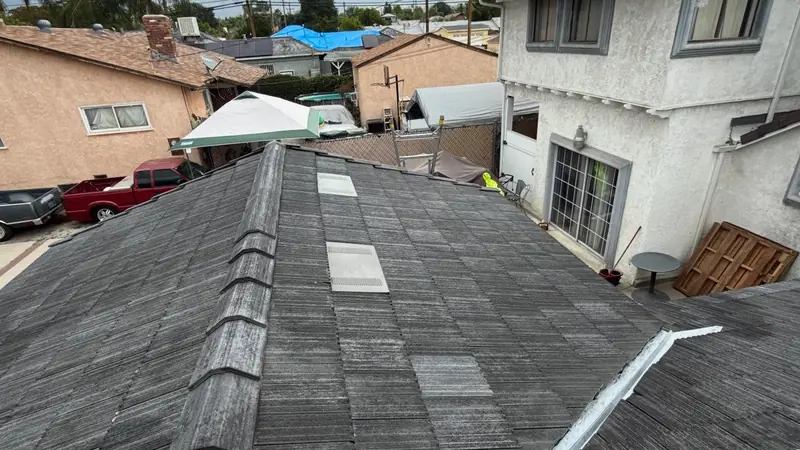
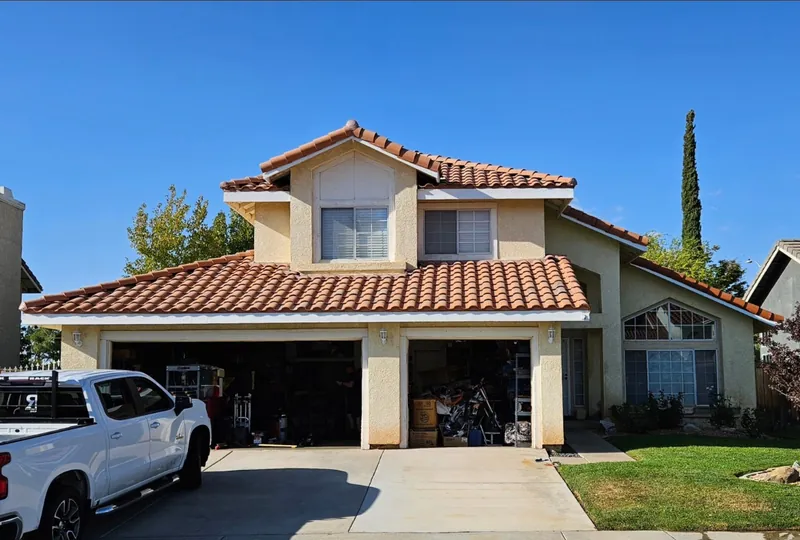
On a tile roof from the 1980s boom, the tiles can still be sound while the layer beneath them has dried out and split after four decades of inland sun. Tile underlayment replacement means lifting and stacking the tiles, renewing the underlayment, battens and flashing, then relaying the originals and swapping in matches for any that crack along the way.
1980s Tract Re-Roofs in Peach Hill and Mountain Meadows
Where the covering itself is worn on every slope, a full roof replacement lets us repair decking and renew flashing that may date to construction. In Mountain Meadows and other tracts with their own associations, CC&Rs can be stricter than city ordinances, so we gather product data for the HOA application before the city permit is filed.
Class A Hillside Upgrades in the Very High Hazard Zones
The Housing Element maps the north and south hillsides, mostly single-family areas, as Very High Fire Hazard Severity Zones. On those slopes we pair a Class A covering with ember-resistant vents, closed eave ends and clean valleys, written up as one fire-resistant roofing scope that answers both the city amendment and the state wildfire code.
Fault-Zone Tile Repair After Strong Shaking
The Simi-Santa Rosa Fault Zone, an Alquist-Priolo zone, crosses southeastern Moorpark, and the northern hillsides are prone to earthquake-induced landslides. Strong shaking can crack tiles, slide them out of their courses and pull flashing away from walls and chimneys. After a felt quake, a tile roof repair visit resets the shifted pieces and reseals those joints before the next rain finds them.
Free Inspections Before the February Peak
February is the wettest month in Moorpark at about 5 inches, so a roof that dried and cracked over the summer meets its hardest test late in the wet season. Book a free roof inspection in the fall and you get photos and written findings in time to fix a valley or pipe boot first.
Mountain Fire, Easy Fire and the Hillside Hazard Zones
Fire has approached Moorpark from more than one side. CAL FIRE lists the 2003 Simi Fire, a 108,204-acre blaze that destroyed 315 structures, as located in Simi Valley and Moorpark. In October 2019 the Easy Fire was pushed from Simi Valley toward Moorpark.
On November 6, 2024, the Mountain Fire started near Balcom Canyon Road and Bradley Road north of Somis during Santa Ana winds, burning 19,904 acres and destroying 243 structures in all. A March 2025 ABC7 report listed Moorpark among the county cities with the most very high hazard acreage.
Moorpark Permits, Code Amendments and HOA Approval
The City of Moorpark Building and Safety Division at City Hall, 323 Science Drive, issues reroof permits and enforces the 2025 California codes. Plan check submittals are electronic only, through the city's Self-Help Online Portal, known as SHOP.
Moorpark has adopted local amendments with stricter standards for foundations, expansive soils, pools and fire-resistant construction, roof materials included. They apply together with the state's own wildfire requirements, which moved on January 1, 2026 into a separate volume of Title 24: Part 7, the California Wildland-Urban Interface Code.