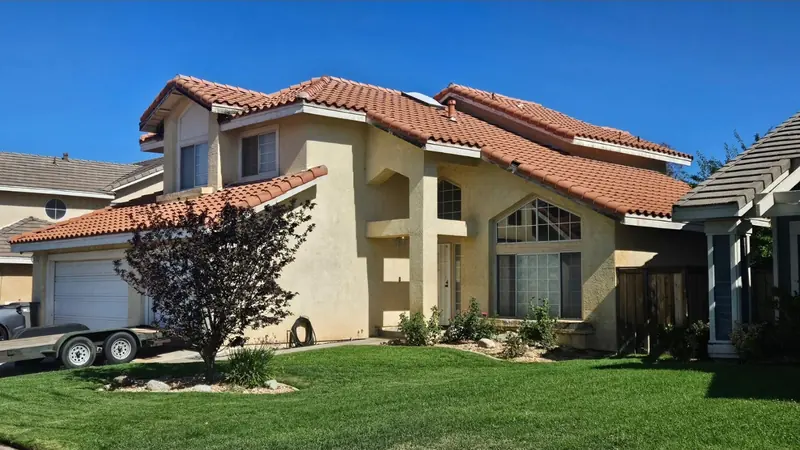
The first question for any roofing contractor in San Marino is style, not price. The city's pre-approved roof list, amended in August 2024, matches materials to architecture: two-piece Mission clay barrel tile only on Spanish or Mediterranean homes, simulated slate on Tudors, simulated shake on a set list of styles, and design review for anything off the list.
Best Top Roofing comes from Camarillo to inspect San Marino roofs for free. We identify the style, photograph the existing roof and write an itemized proposal that names a material the city already accepts, or lays out the review path if it does not.
1920s Estates, Mature Canopy and Foothill Wind
San Marino is almost entirely detached single-family homes, built mainly from the 1920s to the 1960s. Its median home dates to 1943, older than the medians in Pasadena, Altadena or South Pasadena, and the SCAG profile puts 44 percent of homes before 1940.
Period Revival houses on large lots define the city, in Spanish Colonial, Mediterranean, Monterey, Tudor, French and American Colonial Revival versions. Ranch and Minimal Traditional homes fill many pre- and postwar blocks.
Here the weather risk is wind and trees more than fire. Oaks, sycamores, deodar cedars and magnolias line the streets, and the city's hazard plan rates windstorm a High priority hazard, citing Santa Ana winds and mountain wave gusts that can reach hurricane force from mid-October to mid-April. The 2011 windstorm caused an estimated $5.6 million in damage in San Marino.
Oak Knoll, the Huntington and the Early Tracts
The Oak Knoll hills in the northwest hold the city's most prominent slopes, its largest lots and native oak woodland, on tracts laid out between 1906 and 1912. Large houses on large lots there usually mean more staging and longer material runs per job.
Early tracts such as San Marino Park, Los Robles, El Molino and Lake Vineyard date from 1905 to 1908, and the Huntington Drive median follows a former Pacific Electric route. The Huntington's roughly 120 acres, Lacy Park and El Molino Viejo, the mission-era grist mill on Old Mill Road, are the best-known landmarks.
Roofing Contractor in San Marino: Materials by House Style
On the pre-approved list, the style of the house picks the material before anything else does. These five services cover the options San Marino allows and the repairs its canopy brings.
Clay Barrel Tile for Spanish and Mediterranean Homes
Two-piece Mission clay barrel tile is pre-approved only on Spanish or Mediterranean houses, so a Spanish Colonial Revival home can be retiled without design review when material and application follow the list. Our tile roofing work follows the list's details too: cut valleys with flashing, low-profile hip and ridge caps and no 90-degree edge rakes.
Tile Underlayment Re-Lays on Period Revival Homes
Building peaked here from 1913 to 1930, when planned subdivisions filled with large homes. When the tile is sound but the layer beneath has worn out, a re-lay keeps the original pieces: we lift and stack them, lay new underlayment, reset the tile and replace only what is broken. Because material, color and application match, tile underlayment replacement generally falls under the code's matching exception.
Simulated Slate and Shake on Tudor, Colonial and Ranch Homes
The list allows simulated slate only on Tudor homes, with structural calculations when it weighs over 6 pounds per square foot. Simulated shake is allowed on Monterey, Colonial Revival, Neoclassical, Tudor, Ranch, Cape Cod and Minimal Traditional homes, while natural shake is limited to houses with a permitted wood roof. Wood shake roof replacement with a simulated product keeps the look and stays on the list.
Composition Shingles Where the List Permits
Composition fiberglass shingles are allowed only if the house already has permitted composition, if it is a Ranch or Minimal Traditional home not individually significant in the 2020 survey, or if two homes in the legal neighborhood already have it. We confirm which condition applies before proposing shingle roofing. A change of material also means re-roofing accessory buildings.
Canopy Wind Damage and Storm Repairs
The hazard plan's wind table cites about 120 trees down and 11 homes red-tagged in a single San Marino wind event. Falling limbs crack tile, punch into decking and strip ridge caps. After a storm, call during business hours and we prioritize active leaks, then complete the roof repair in matching material so it stays inside the city's review rules.
Design Review Approvals and Building Permits in San Marino
A full or partial roof replacement needs Design Review Committee approval unless the material, color and application match what is being replaced, or the material is pre-approved. The Community Development Director may still refer any roof to the committee, which weighs fire, wind and earthquake safety, structural integrity, view exposure and rainwater disposal.
Design review applications are filed in person with the Planning Division at City Hall, 2200 Huntington Drive, and applicants must hold a San Marino business license; a minor review costs $805. Building inspections run Monday through Thursday only, and construction is not allowed on Sundays or listed holidays.
No part of San Marino is mapped Very High, but the city designates a local Fire Enhancement Zone in the northwest Oak Knoll hills for wildland-urban interface brush fire risk. Statewide, the California Wildland-Urban Interface Code became Part 7 of Title 24 on January 1, 2026, replacing CBC Chapter 7A. Whether San Marino applies it to that local zone is not spelled out, so we ask the Building Division on each Oak Knoll job.